Saturday, 14 January 2012

Voyage on the Sir Winston Churchill ~ part 4

March 1997
 

Saturday, 22nd March


We passed through the Alderney Race during the night, and our Watch had just missed this event when our wake-up call came at 0330hrs for our watch to begin at 0400hrs. We were amply compensated however, as the sunrise we witnessed on this morning was just as stunning as the previous evening’s sunset. The comet and stars gently faded into the light, and the rising sun lit more and more of the foreign coastline ahead.


The sea was as flat as a mill pond as we continued towards the Bretons coast, so it was decided to practise a man overboard drill. A dummy, affectionately known as the Accountant, was jettisoned and when the man overboard alarm – 7 short then 1 continuous blast on the ship’s whistle – was sounded, all hands rushed to their muster stations. As the dinghy is stowed aft it was our responsibility as Mizzen Watch to launch it, and the Boatswain and Cook went off while the Doctor readied his medical kit. Once the Accountant had been rescued and was safely back on board, our Watch had to hoist the dinghy back aboard and stow it away again.

Our arrival to the walled port city of St Malo in Brittany, northern France, was as spectacular as ever. I got to take part this time as we manned the yards, and we all sang sea shanties that the Mate had taught us during the 0900hrs briefing. And when we ran out of shanties? We just sang any song we could think of! We were up on the yards for about an hour altogether, waiting for the lock gates to open, then close again, the lock to fill, and the gates on the other side open to allow us into the dock.

As we climbed down from the yards a mad/drunk/both Frenchman in a pseudo military uniform provided entertainment by shouting French obscenities and suggesting we did strange things with various parts of our bodies, until the Doctor told him “Je suis bien, merci!” and he walked off, still shouting to himself.

We conducted the usual harbour duties: mooring the ship, putting up the gang plank and doing ‘spaghetti runs’, which involve going around the whole ship and tidying all of the lose ropes into neat coils. We then had the next installment in the inter-watch competition: rowing the lifeboat across the dock and back against the clock. This we also lost, and I must admit that I was a bit disappointed not to be part of our rowing team.


Shore leave was allowed until 1500hrs, and a few of us went to visit the old town within the city walls, and changed our money into francs with which to buy postcards and stamps.

Later in the evening we were allowed more shore leave, to return by 2330hrs ship time, so we all went out to the local pubs to ‘splice the mainbrace’. Brittany is one of the Celtic nations, and there were a great many Celtic bars and Irish bars. The two of us crew who were Welsh were made very welcome as fellow Celts, so it was hard to get back for the end of shore leave. On return to the ship I tried to get a little sleep before my next watch.


Sunday, March 23rd (and our Watch Officer’s birthday)


I was on harbour watch at 0100hrs, then back to bed at 0200hrs. We were woken for breakfast, then given a packed lunch and more shore leave to enjoy the small city before we left harbour to once again head back to sea.

Our number 8, Charlotte, and I took a walk through the town. We stopped in a patisserie along the way for delicious freshly baked snacks, before continuing to the Musee Internationale Du Long-Cours Cap-Hornier in the Tour Solidor. This 14th century building housed a collection tracing the history of voyages around Cape Horn, including models, nautical instruments and objects made by the sailors during their crossings or brought back from foreign ports. The museum, invoking thoughts of travel aboard extraordinary tall ships at the end of the 19th and the beginning of the 20th century, seemed a very appropriate excursion for us.


After the museum we made for the small beach, where we sat sunning ourselves while we ate our lunch and wrote our postcards, before heading back to the old town to search for postboxes.


On returning to the ship we discovered that we had acquired a new number 13 for our Watch. Steve had been travelling around the world from his home in New South Wales, Australia. He had bought a bicycle in Greece, and from there he had eventually cycled all the way to St Malo, ready for a ferry to England and the next stage of his journey. Steve had worked as a crew member on chartered tall ships in Canada, and had come over to admire our ship. He had got chatting to the Captain, and as we were short of crew, the Captain had offered him and his bike passage to England which he gladly accepted. A much more fitting end to a cycle journey across Europe!

We left St Malo as spectacularly as we had arrived, with people singing up the yards. Then we set course north again, headed for the Cornish coast.

The weather was turning rougher again, up to force 6 on the Beaufort Scale which means that long waves begin to form, white foam crests are very frequent and some airborne spray is present. The increasing waves meant that there was some more seasickness, although by now most had found their sea legs, and yet again we spent a bumpy night at sea.


Friday, 13 January 2012

Voyage on the Sir Winston Churchill ~ part 3

March 1997

Thursday, 20th March


It was all hands on deck after breakfast to prepare the ship for leaving port. John and I from our Watch were under the Boatswain’s (Pronounced ‘bosun’) charge to let go the mooring lines from the quayside. The Boatswain is a senior member of the ship’s crew who is responsible for the rigging, anchors, cables, sails, and other items that keep a ship running smoothly. They are like a foreman of the ship's crew, as they issue orders to the deck crew.


As we were left ashore from letting go the moorings, we had to return to ship in the dinghy and climb up the ladder aboard, just like something out of a good pirate film.


Mizzen Watch were duty Watch again, and I was starboard lookout and had to keep watch with binoculars for ships and buoys that were on our course. Technically motor ships should give way to sail, but larger ships such as tankers have such large turning circles that it may not be physically possible for them to change course to avoid us. My job was very important as we were heading into some of the busiest shipping lanes in the world, as we headed away from Weymouth and south, towards the French coast.


The rest of the day was plain sailing as the wind had dropped considerably from the strength of the previous night – so much so that we even had to motor-sail part of the way. We spent our second night at sea, this one much calmer than the first.


Friday, 21st March


The following day brought another day of plain sailing. The weather was glorious, no-one was sick, and despite being only early Spring most people even got sunburned. As the weather was so fine, the sun so bright, and all but one sail was set we launched the rubber dubby (the ship’s dinghy) and a small party of designated photographers went out with all of the crew’s cameras to take pictures of the ship in her near-full glory.


We did our watches as usual, Mizzen had the second dog watch, from 1800hrs to 2000hrs. Most watches are four hours long, and you would spend one watch period on standby, ready to be called or woken in the event of an emergency, then start duty on the next watch, then have your rest. With three Watches of crew rotating through six work watches in 24 hours, obviously everyone would always be stuck on the same timings each day. Therefore one four-hour period is split into the two dog watches, meaning there are 7 watches in total and the crew rotates onto different timings each day.


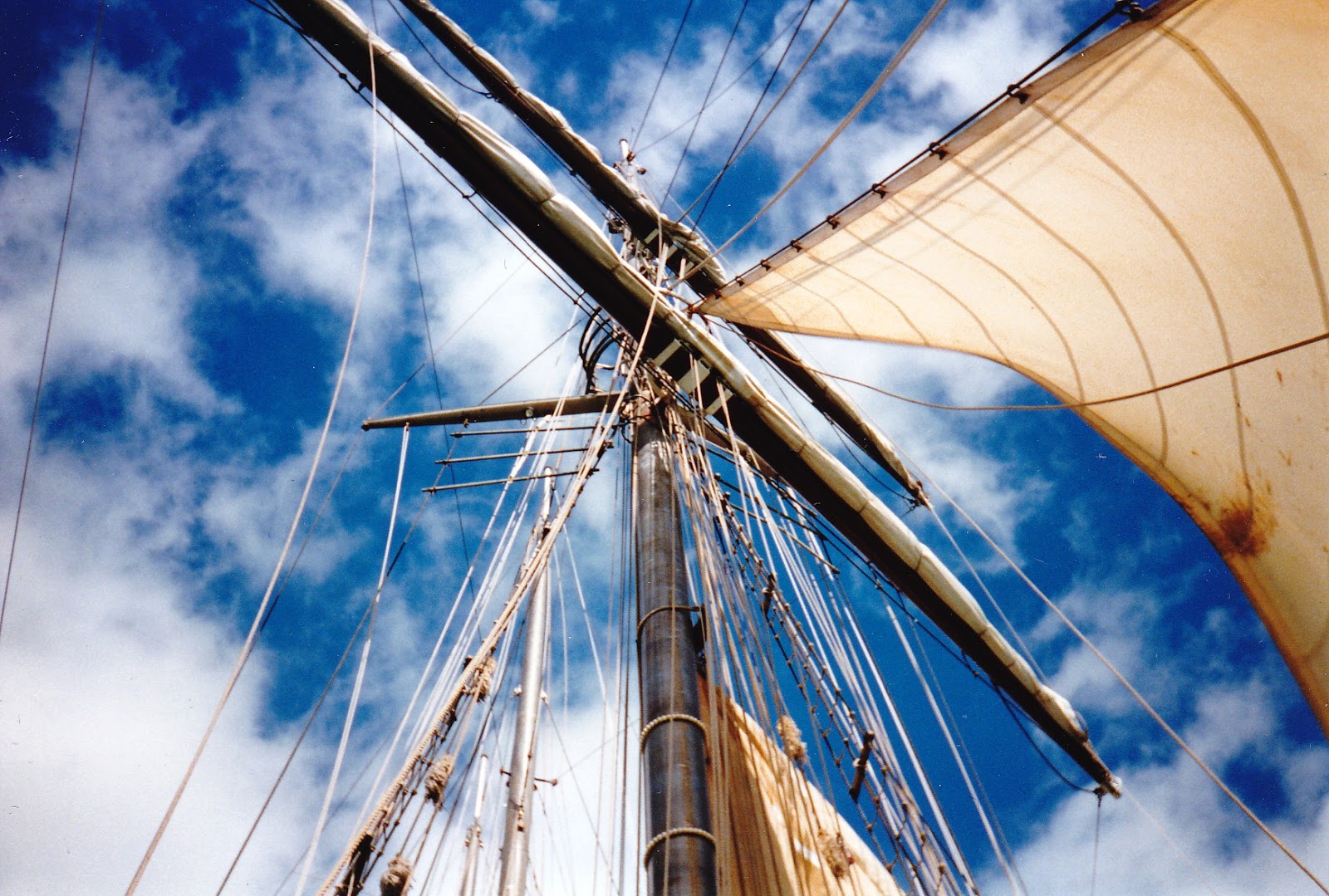
We had been up in the rigging setting the square topsail before darkness arrived, and as we were descending the ratlines we were treated to the most beautiful sunset. In the middle of the channel, with no light pollution, the darkness also brought us not only a brilliant array of stars, but also spectacular views of the twin tailed Hale-Bopp’s comet which, although I didn’t know it at the time, was then very nearly at its closest point to the Earth.


We absorbed this spectacular view and enjoyed the calmness for a while, but we didn’t linger too long as by this point we had learned to sleep whenever the opportunity presented itself, so we were all early to bed after watch.


Thursday, 12 January 2012

Voyage on the Sir Winston Churchill ~ part 2

March 1997

Tuesday, 18th March


There were various duties aboard ship that one person from each watch would be detailed to perform on a rota basis, and as number 11 I was woken at 0700hrs on the first morning to work in the galley. The galley rat duties are not much fun – serving food, peeling veg and washing up – so it was good to get this over and done with early on.

We left Poole harbour at 1000hrs in spectacular style, with crew members manning the yards and singing shanties, although us galley rats weren’t able to see from below decks. With the weather conditions as they were we were heading west with the aim of voyaging to Ireland, although where along the coast we would make land was entirely dependent on how the winds held. To begin with the weather was windy but not too rough, however it got choppier as the winds rose and many people were struck with seasickness. I was reminded of my father telling me that there are three stages to seasickness: you think you are going to die, you know you are going to die, you wish you could hurry up and die!

The galley rats had one break before the evening meal so we got fresh air and took some photos of the white cliffs we were leaving behind, however this left us feeling ill on return to the galley. I could only pick at supper after seasickness overcame me, and it was bed at about 2000hrs for me and the other sick galley rat.


Leaving behind the white cliffs of southern England


Wednesday, 19th March


I was woken accidentally at about 0300hrs as Mizzen Watch was urgently needed up on deck, however as a galley rat I wasn’t on Watch duties yet, and so I wasn’t required. When I was woken at 0730hrs for my galley duties (after my disturbed sleep I was late!) I found out that during the night the winds had risen considerably. The Captain had judged that the strong, gale force winds were too much for us, and in the process of wearing ship (turning) in order to return to shelter under the cliffs the sail at the rear, the mizzen sail, had ripped. This was the emergency Mizzen Watch had been called for, as the ripped sail had to be taken down to avoid causing any damage to the ship. We had been forced to return under motor to Swanage Bay on the south coast, where we had anchored in the shelter overnight. 

Later in the morning we continued on under our remaining sails, with the assistance of some motor power, along the coast to Weymouth so we could offload our damaged sail and collect a new one. This was essential as the mizzen is the most important sail for providing power to the ship.

At 1000hrs that morning my galley rat duties came to an end, and it was bye to Ben and Becca my fellow 11s from the other Watches, and hello to my own Watch. I’d missed out getting to know my fellow Watch members and learning about the ship during that first day under sail, but I was still glad to get my galley duties over and done with early on.

On entering Weymouth our Watch was the duty watch, and the two off duty watches got to man the yards as we entered harbour. Our duty was soon over, and the next duty watch had the job of folding the torn sail to carry it off the ship, before loading on the new one.

Folding the new mizzen sail...

... and carrying it aboard


After this we had the first of the inter-watch competitions that were to take place throughout the voyage, beginning with a heaving line contest (which we won) and a tug o’ war (which we lost). In the evening shore leave in Weymouth was allowed from 2000 to 2300hrs, but Weymouth was very strict about age limits in the pubs so unfortunately the only place I could get in, let alone get served in, was a McDonalds!

Inter-Watch tug o' war - our team

A two-man harbour watch was kept up throughout the night with each person on duty for one hour. I headed back to the ship for my hour at 2200hrs, then afterwards sat up in the half deck awhile, getting to know my fellow crew members before bed.

The voyage had not had the most auspicious start, but the winds had changed and it was exciting to sleep listening to the water lapping at the hull of the boat, wondering where the new winds would take us.


Wednesday, 11 January 2012

Voyage on the Sir Winston Churchill ~ part 1

March 1997


Monday, 17th March


We met the ship at Poole town quay on Monday 17th March, and had boarded by 2pm, or 1400hrs as we had to call it, as work on the ship would be a 24 hour affair. We were greeted by members of the permanent crew and the volunteers who we were to be living with on board for the voyage. Upon boarding the ship we were told our watch and watch number, and shown our bunk and locker.

STS Sir Winston Churchill
There were three Watches with 13 trainees, a Watch Leader and a Watch Officer in each. The Watches were named for the ships 3 masts, with their muster stations next to their mast: Fore Watch, Main Watch and Mizzen Watch. I was Mizzen 11 (Z11) and my bunk was next to the female toilets, or heads – yuk! I was in the top bunk, with Z12 and Z13 bunks below me, and opposite were the three Watch Leaders.

My bunk was the top one, lockers were below the bottom bunk and the ceiling was just a few inches above my bunk!

Some of the trainees were late to arrive, so the Captain’s briefing was postponed and instead each Watch did some preliminary training. We learned some ropes, knots, parts of the ship, and went ‘up and over’ – climbed up one side of the ratlines, into the crow’s nest and down the ratlines the other side. When the late trainees finally arrived everybody signed on in order, F1 to Z12 (we were short of crew members and there was no Z3 or Z13) and handed in passports and any valuables to the Purser. We were also given our uniform smocks and each had a badge denoting our Watch and number. While waiting, as our watch was last, we sat at our muster station and all got to know each other a bit.


The Captain’s briefing followed the signing on, and we were formally introduced to the permanent crew and volunteer helpers. We had an evening meal, and continued the training with learning how to ‘make up’ and ‘let go’ the running back stays (runners) which we need to do when tacking or wearing – turning – the ship. We also learned about the ships routine: the watches, or shifts of working, the daily ‘happy hour’ where everyone has to muck in to give the ship a thorough cleaning (“A clean ship is a happy ship!”), and the additional duties working in the galley, mess, or with the Boatswain.

Once training was complete we were allowed shore leave in Poole to celebrate St Patrick’s Day. We found a nice Irish Pub, but everyone had to go easy on the Guinness.  Shore leave ended at 2300hrs, with lights out at 0100hrs, but sleep did not come easy as excitement brewed about the voyage beginning in the morning.


Tuesday, 10 January 2012

My First Travelogue


When I was younger I had an unprecedented spot of luck: Pembrokeshire, where I grew up, was home to a number of oil companies and their refineries, and unbeknown to me at the time one of the oil companies (I cannot remember which I’m afraid) used to offer sponsorship to members of youth groups. Now I have no idea how this came about, literally the first I heard about it was when I was selected, but through my membership of the Scouts my name was chosen for sponsorship on a tall ship voyage with the Sail Training Association. I couldn’t believe it! It was all very short notice and all very exciting, and, having the kind of mum who believes that travel and adventure are an important part of life, I was allowed to go. It was amazing. I was 17 years old and was about to embark upon a 2 week sailing voyage in a genuine tall ship!


Dar Mlodziezy by Bruno Girin at flickr, via Wikimedia Commons.


Tall ships had really captured my imagination ever since 1991 when the Cutty Sark Tall Ships Race began in my home town. The local dock, which previously had been home to trawlers and fish markets, was revamped into a ‘marina’ (oooOOOooo!) and the adjacent part of town was given a huge makeover. Grotty potholed roads were replaced with smart block paving, and new ironwork bins, benches and lamp posts were installed all around. Tall Ships Race fever came to town planning, local schools, basically everywhere in the town. Lessons in my primary school were given around tall ship recognition – do you know your sloop from your ketch? Your barque from your brig? Tall ships became the subjects of school art competitions and school visits were organised to the new marina and to look around the ships that had congregated in advance of the start of the race.


Thanks to the fact that my dad’s work was based with the refineries, as a family, we were even allowed to visit on board the largest ship entered into the race, the Dar MÅ‚odzieży. This ship is the first Polish-built, ocean-going sailing vessel to circumnavigate the globe, and at nearly 360ft in length, it couldn’t fit into the docks. Instead a berth had been arranged at a jetty of one of the oil refineries, where the oil tankers would berth to offload their cargo of crude oil for refining. In case you’re wondering how to pronounce Dar MÅ‚odzieży, my best tranliteration is: ‘Darmladjetsy’. I remember that a crew-member taught my mum how to pronounce it, and she taught me by likening it to “darn m’jersey”, which has just stuck with me!

I was also a reasonably accomplished dinghy sailor by the age of 17. During summer holidays from school, rather than getting a child minder to take care of us, my mum (who worked long hours) would often enroll my brother and I in some form of activity to keep us occupied. One summer this had involved learning to sail in tiny Optimist dinghies on the lake below a local castle. We both took to this like ducks (or dinghies!) to water, and the following year became founder members of a new sailing club. I took part in race seasons locally and my brother even went on to be part of the Welsh Sailing Team in the Topper class.

So you see how the stage was set for my excitement at winning this trip!

Conscientious as I was back then, I wanted to make sure that I showed my gratitude to both the Scouts and my sponsor, so I supplemented my photos with a diary-style travelogue that I wrote during the voyage, and afterwards I made the lot into a presentation. Some time ago, in the process of moving house, I once again stumbled over this diary. I had found the photos before (they really are bad – the camera I had back then was one of those film 35mm cameras you used to get that was so basic it didn’t even take batteries. No zoom, no features, just point, shoot and hope. But excellent memories none-the-less) but I had completely forgotten that I had even made a diary of the trip. My first ever foray into travel writing, in fact. It was fascinating to read it again and be reminded of bits of the voyage that had completely escaped my memory.

So I thought I would edit my little travelogue slightly and put it here in installments. My very own account of my two weeks at sea in the STS Sir Winston Churchill, by 17 year old me :)


Sunday, 20 March 2011

Multi-Pitch Climbing in Snowdonia


I have a lonely weekend looming, and I want to do something good with it. An old school friend of my husband’s is into rock climbing, and is pretty experienced too, so I decide to get in touch to see if he’s free. Getting his number, I send a message asking if we could hit the crag together. When the reply comes it’s an enthusiastic ‘yes’, and the wheels are set in motion for a weekend on the rock.

We are lucky, and when the time comes the weather is cold but fine. Marcus has invited another of his climbing friends, Stu, and we all meet up at Marcus’s place in the Midlands the night before to discuss plans and prepare kit. We have a great laugh, swapping stories and having a few drinks, the banter between Marcus and Stu is hilarious and they seem to have a lot of funny anecdotes about things going wrong, and getting caught out in the dark and sleeping on mountainsides.

The next morning we have a long drive ahead of us to North Wales’ Snowdonia National Park, ready to take on the multi-pitch ‘Grooved Arête’ route up the east face of Tryfan, so of course we all wake up late and then waste more time seeking out the best local Staffordshire Oatcakes for a hearty breakfast.

Eventually though we make it to the base of the mountain, I have summited Tryfan before, a mixture of hillwalking and scrambling to the top, but this will be my first rock climbing here and I’m looking forward to it.


We have a bit of hillwalking to do to get to the base of the climb, but the guys know the area well and lead the way. They will also be leading the route between them, as I don’t have the ropework skills for leading and can only second. At each pitch the guys will swap over the lead, but I will join in with belaying when I’m not climbing. 


We have packs with us containing food and drink, plus plenty of extra clothing for the cold weather. It’s not particularly freezing, but sitting still to belay in the shade of the mountain then the cold really gets to you. While we gear up and pack any loose stuff away, we take in the great views of the valley below us.


Then the climbing begins, with Marcus leading the first pitch.


This is my first proper multi-pitch climb, and apart from disliking being cold, I’m finding it exhilarating. It’s so peaceful on the mountain where we are, and the views are fantastic. Trad climbing like this is always a slow affair while you are waiting around, the leader having to pause to place protection in the rock face, and then the wait while they set up the next belay safely. But with this slowness comes a chance to reflect on the joy of being outdoors, doing something fun with great people, and having a feeling of achievement at being there.


When it’s my turn to climb I take a few minutes to get warmed up, my poor cold fingers protesting at being put to work. Although I am carrying a pack and collecting extra gear as I pass it, I don’t find it too strenuous and cope easily enough with the climbing to find it pretty smooth, while it is still challenging enough to feel like I am earning my time there.


We climb higher and higher, achieving pitch after pitch, but eventually the slowness of climbing with three people and the lateness of our start catches up with us, and the sun sinks lower. As the sky darkens, we put on more warm kit and eventually have to dig out our head torches. I see now that I should have paid more attention to those earlier stories of getting stuck in the dark and sleeping on mountainsides.

The moon


It’s all good fun though, and I eventually begin my climb up the final pitch. At one point I get pretty stuck, and just cannot work out the move I need to follow the route. I make attempt after attempt, suffer failure after failure, and fall a couple of times to be saved by the friction of the rope through the protection and the belay. I start to despair a little – the rock above means that the others haven’t heard me shouting to them that I’m struggling, I can’t go down but am unable to make the move I need to continue up. I can’t get out of my head the worry that I’m stuck there and I don’t know what to do. Feeling the panic rise, I have a word with myself: Stay calm. Panicking will make things worse. Take a pause, catch your breath. Reset yourself and try again, but don’t rush it. Regaining my calm, I at last make the move I need. The next pieces of gear were holding the rope at angles, and are tough to remove as falling on the rope has jammed them tighter into the rock cracks, but this is a small price to pay for the job of saving a fall.

Finally I reach the top of the route, the boys are in good spirits; they had thought I was taking my time but hadn’t realised anything was wrong, which is fine by me. 


We pack up all the gear and have a laugh about having to descend in the dark by head torch, before finding a pathway down the mountainside.


The next day we head to the Roaches area in England’s Peak District National Park for a day of fun single pitch climbing. 


We tackle several different routes and have great time, but for me the real highlight has been the multi-pitch climb, nothing can top that :)


Wednesday, 9 March 2011

In Pictures: Hiking the Glyderau

If you like, you can click on the first image to open the pictures, then you can simply click through them.

The Glyderau are a mountain group in North Wales' Snowdonia National Park. We hill walked, including sections of scrambling, the highest peaks in the range, Glyder Fawr (1,001m) and Glyder Fach (994m).


A scramble section, complete with ice!

Ice formations - the picture isn't blurry, that's how the crystals have formed


Looking back to Tryfan

The Ogwen Valley, from the summit of Glyder Fawr

Beautiful ice formations on the rock

One of the scrambling sections


The Cantilever Stone, near the summit of Glyder Fach

Castell y Gwynt, (Castle of the Wind)