This is not me being adventurous in any way, but it was so impressive I decided to post it anyway.
Sunday 14th September 2014 saw the Ironman Wales event take place in Pembrokeshire.
Sunday 14th September 2014 saw the Ironman Wales event take place in Pembrokeshire.

Starting
and finishing in Tenby, the participants begin with a 2.4-mile (3.86 km) swim
in the sea off Tenby. Having got out of the water they then have to run up the
hill into Tenby town to transition to their road bikes, ready for a 112-mile
(180.25 km) bicycle ride through the beautiful Pembrokeshire countryside. As if
all that isn’t enough, on completing the bike course they then have to swap
their bike shoes for running shoes, and complete a marathon! 26.2-miles (42.2
km) of running after all that!
These
are obviously epic distances, but the Ironman has a strict time limit of a total
of 17 hours to complete the race. The race starts at 7:00 am, and cut off for
the swim is 9:20 a.m. (2 hours 20 minutes), the bike cut off time is 5:30 p.m.
(8 hours 10 minutes), and the mandatory marathon cut off is midnight (6 hours
30 minutes). Any participant who manages to complete the triathlon within these
timings becomes an Ironman, although I think that anyone who can keep going for
17 hours deserves some recognition,
even if they don’t finish the entire course!
The
day began for us with me walking over to my friend’s house, and then she drove us
to Tenby. We were hoping to see some of the swimming, but by the time we had
caught the park and ride service that was running for the supporters, and made
our way through the crowds, we realised that it would take a while to make our
way to the area where we would be able to see the swim. Unfortunately we didn’t
manage this, but soon after our arrival the first swim finisher came running
towards transition. We found that we had a good spot to watch the swimmers run
in towards the transition point, where they would transform into cyclists, and
whizz back past us in the other direction.
 |
| Some of the cyclists are still getting things ready this soon out of transition |
 |
| Running in and cycling out, past the town walls of Tenby |
We
stayed in that place until the very last competitor had gone through. Sadly
many people didn’t finish the swim – some had never swum in the sea before, and
simply weren’t prepared for the challenge. Others sadly succumbed to
seasickness due to the choppy conditions – this seemed really awful, as all the
preparation they must have done simply ended in an unavoidable early finish.
Even
this early-on however, we got to see some really nice examples of the sportsmanship of the athletes
taking part: there was an accident with a cyclist falling off. I couldn’t see
it happen, but from people who had a better view I think this was because a
couple of bikes were close together, but they had to brake to avoid spectators
who were crossing the road. These crossing points were controlled by marshals,
but at this point there was some lack of thought going into it, and they were
letting too many people cross at once – meaning that the pedestrians couldn’t squeeze through
the gap in the barriers quickly enough to be out of the way when more cyclists came – there were
lots of ‘boos’ from the crowd at this. Anyway, the outcome was that one cyclist
came off his bike. He had to fiddle with the bike quite a bit to get things
running smoothly again – a finely tuned road racing bike can be delicate to falls. While he was
struggling with this, another cyclist came round the bend and saw him, and
stopped to help! The roars of the crowd when these two got on their way again
were huge. Lots of support for those
two!

Another
guy had his wife and tiny son (about 2 years old maybe?) waiting opposite me to
cheer him on. As he came into sight the wife pointed out to the little boy “Look!
There’s daddy!” The dad spotted them too, and pulled over to give them a cuddle
and get a photo taken! Very cute!! Afterwards the little boy was so excited,
and kept calling out “We saw daddy! We saw daddy!” A bit of a melty-heart
moment!

Most
importantly for us though, was spotting our friend Chris as he went past. I’ve
known Chris since I was about 12, when I joined Scouts. His dad Harry was the
Scout Leader, and it was a really great group. Sadly, Harry died from cancer
last year, and Chris decided to take part in the Ironman to raise money for
Macmillan Cancer Support.
This is also a charity close to my own heart, as their help and support was
invaluable when my own dad was dying from cancer back in 1999. Even more
impressive is that just last week Chris was in an accident while training on
his bike, getting knocked off by a tractor! His JustGiving page is here if Macmillan is a charity you like to support.
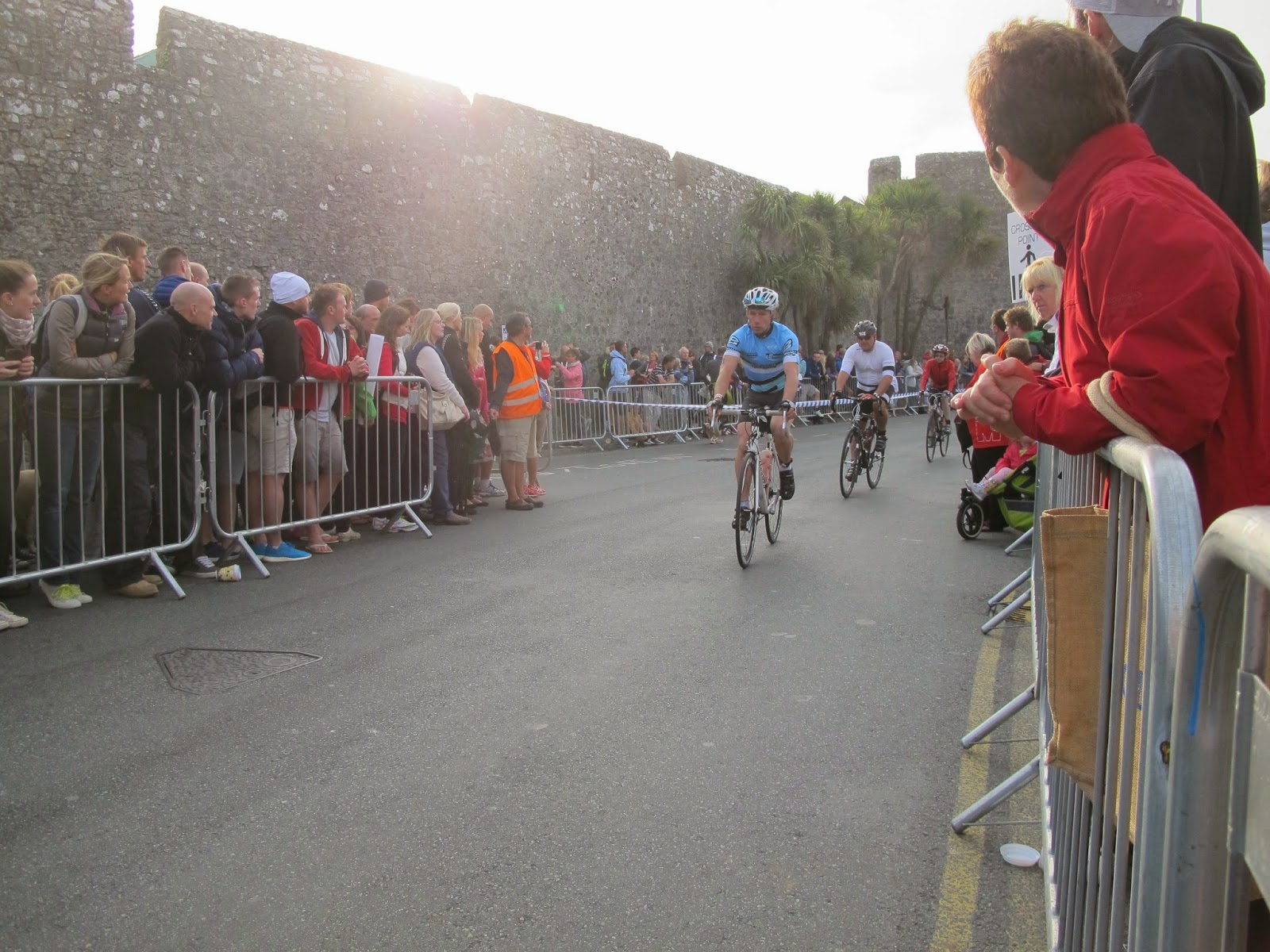 |
| Chris (in the blue top) beginning the cycle ride |
Once
all of the cyclists had gone past, we made our way back to the park and ride
bus service, to get the car and move on somewhere to watch the cyclists.
 |
| Tenby Loves Ironman (and -woman!) |
We
went a short way to the village of Carew, where we were able to sit on the wall
of a small bridge and cheer on the riders. This section was a 2-lap section,
and on the first time around many of the riders were in great spirits – lots of
smiles, shouts of thanks for the support, and even some funny comments as they
whizzed by!
 |
| Cyclists at Carew |
We
spotted Chris here on both of his laps, but I wasn’t quick enough with the
camera to get a good shot of him unfortunately. The only picture I did get was
this one of him as he headed up the next hill. He’s the bottom rider in a blue
shirt in this picture, but he proved a strong climber and was overtaking other
riders up the hill until he was no longer in sight.

By
2pm we were getting pretty hungry, so we headed back to Tenby again to get some
late lunch. Already there were Ironman athletes beginning the marathon, so we
followed the course up through town, cheering them on as we went, until we got
to a lunch spot. Refuelled, we spent the rest of the afternoon moving from spot
to spot to cheer on the runners. The marathon was a 4 lap affair, so as more
cyclists finished and got their trainers on for the run, the course got busier
and there were more people to cheer on.

The
athletes were given coloured bands to wear, a different colour at each
lap, so you could see how far along they were. The lead male and female
athletes were also accompanied by a cyclist displaying a sign telling
you they were in the lead - plus the motorcycle film crews. Here is the
lead male running past:

We
were pleased to see this guy too - we had spotted him going to the
transition on his sticks, and were amazed to spot him a few times on the
marathon circuit:

He was richard Webster, an ex-Wales and British Lions rugby star. He was using the crutches to take the weight off his legs after a long rugby career requiring multiple knee operations.
After a while we found ourselves on a small side street. A lady opposite was cheering people on by name, and we realised that the athletes’ numbers, which they now had to wear on a band around their waists, had their names written in small letters beneath the race numbers. So when this lady moved on – having spotted the athlete she was looking out for - we began cheering their names as they passed. We are both very quiet normally, and we really surprised ourselves with how enthusiastically we were shouting! We soon really got into it, spurred on by the gratitude some of the athletes showed at just having a little extra support.
After a while we found ourselves on a small side street. A lady opposite was cheering people on by name, and we realised that the athletes’ numbers, which they now had to wear on a band around their waists, had their names written in small letters beneath the race numbers. So when this lady moved on – having spotted the athlete she was looking out for - we began cheering their names as they passed. We are both very quiet normally, and we really surprised ourselves with how enthusiastically we were shouting! We soon really got into it, spurred on by the gratitude some of the athletes showed at just having a little extra support.
 |
| Our cheering spot |
So
enthusiastic
were we, that soon the whole street-full of supporters was
shouting on the athletes by name! We saw Chris go past this spot twice,
although we only just spotted him the first time as he was no longer in
blue, having changed into his Macmillan top for the run!
 |
| A bit of a smile this time, and a thumbs up! |
We
had to move on after a while, as my friend’s little boy needed the toilet. The
street near the public loos was pretty quiet, so while we were there we took up
our cheering tactics again, and soon had more people cheering on the athletes
again.
 |
| Another inspiring athlete, carrying on despite injury. I hope he made it! |
Our
next spot was on an uphill section. The pain on the faces of the runners was so
evident, and we shouted even harder to encourage them up the hill. By this
point our hands were red and swollen from clapping, our voices were very
hoarse, and it was getting dark. We stayed as long as we could, but it was a
Sunday and my friend’s son needed to get to bed, ready for school in the
morning.
We
both felt guilty that we couldn’t stay to support everyone right through – we
had been there for over 12 hours, and would have gladly stayed until midnight I think, as we had so thoroughly gotten
into the spirit of it! We had even been filmed a few times by the cameramen
capturing the event, as they were so impressed with our cheering!
I hope all the athletes who took part are having some well-earned rest today!


