Wednesday, 16 April 2014

Inca Jungle Trek, Peru ~ Day 3


Foreword: from November 2013 - February 2014, I went on a backpacking trip in South America, visiting Peru, Ecuador and Bolivia. 


Of course all good things must come to an end, and it was time to get out of the wonderful hot springs, get dressed back into our cold wet clothes, and get to our accommodation for the night and dinner. The accommodation was very basic – one bathroom between about 20-something people, and my room was crammed full with 7 beds and barely enough room to walk between them.

Santa Teresa, our town for this night, while small still had a lot more going on than had Santa Helena. There were bars and discos to enjoy after dinner, but most of us were too tired to contemplate this and so we chatted with each other when we got back to our hostel before going to bed. Some people did go out however, and I don’t think they enjoyed the next early start one bit!

At dinner we had been given a presentation by a representative from a zipline activity centre. So for Day 3 of the trek we had the option to trek for a full day, or to go ziplining – including a 1km zipline, claimed to be the longest in the world – then just trek for a couple of hours in the afternoon.

Grace and me all geared-up at the start


Although an extra expense, it wasn’t too much (equivalent to £20 or US$30) and so I opted for this easier option. There was some steep uphill walking involved in getting to the high point to start ziplining, but not hours of it by any means. 

We whizzed down several ziplines, and although they involved being suspended by a single cable above the ground far below, they seemed much more enjoyable than the plywood crate of the previous day! I can sometimes be pretty scared of heights – earlier in the trip I’d got really anxious just climbing up the tower of a church in Quito – but on this occasion I was feeling pretty brave and took it all in my stride. 

The first zipline - about 400m long


One of the ziplines was said to be the longest in South America, and I've even seen some claims that it's the longest in the World! At 1000m (1km) long, you can barely even see the person on it as they near the end. You need to tuck-in as you zip along to keep enough speed to make it to the end. I managed to zip all the way to the end of the line, but several people - either because they were enjoying the ride and taking photos, or simply because they couldn't hold the 'tuck' position the whole way - had to haul themselves up the final bit. Although the ziplines are taut and on a slight decline, there is still enough weight in the cable that they have a curve in them, meaning the last bit is slightly uphill. Of course you could make the cable downhill all the way, but this would be really dangerous as you would go so fast with a very sudden stop at the end!

The kilometre-long zipline


The kilometre-long zipline - less than half-way and see how small she looks already?

The final zipline had a platform attached to it before you reached the end, from where you transferred from the zipline itself to a rope dropping to the ground, down which you abseiled back to the start point. A very neat finish!

The final zipline - you can't really see the platform but it is there!


From here the plan was to get a minibus to meet the rest of the group – those who had chosen to hike all morning – and go for lunch at a spot near the railway line at Hidroelectrica, the hydroelectric plant. This plan came unstuck as the rainy season causes the rivers to swell, and meant that the road we needed to take was impassable for the minibus as the bridge had gone down. We therefore had a short hike before lunch, over a makeshift bridge and on to Hidroelectrica for lunch. 


Crossing the makeshift bridge, you can see the diggers and things in the background clearing away the damage ready to rebuild.

As we hiked towards the lunch stop we had views of Machu Picchu Mountain, and it was heart-flutteringly amazing to know that nestled up there, the other side of that mountain peak, was the fabled site of Machu Picchu.

Pointing to Machu Picchu Mountain. And looking chubby thanks to lack of exercise in the previous 10 months!


As we ate our lunch we were told that we had the option afterwards of either hiking 2 hours to the town of Aguas Calientes, or taking the train. No-one else opted for the train, and so my competitive spirit dictated that I didn’t either. I wasn’t too worried as the following day I could take the bus up the mountain to Machu Picchu if I needed to. So after lunch we set off to trek along the railway line to its termination at Aguas Calientes.


This was a long trudge, but 2 hours didn’t seem like too much. Of course 2 hours was actually more like 4, and I was getting pretty tired. This was NOT helped by finding out, at the point that it was too late to do anything about it, that landslides on the road up to Machu Picchu meant that in actual fact, I would not be able to get the bus the following morning. This kind of annoyed me, and I was pretty anxious about how my hip (and fitness levels) would hold up. Luckily, being South America there was plenty to keep me interested and distracted along the way. Flocks of parrots in the trees (silhouetted with the branches so I still couldn’t get photos), colourful butterflies everywhere. 


Grace is a geology graduate and was pointing out interesting rock formations, and I even spotted some leaf-cutter ants carrying out their work. They cut the leaves and carry them back to their colony as sustenance for the nutritious funghi that they cultivate for food. You don’t think of ants carrying out agriculture do you? We had only ever seen them on TV before, so we stopped to watch them for a while as they carried their heavy loads.


We eventually reached the point where we could leave the railway track, pass the bridge we would cross tomorrow on our way to Machu Picchu, and follow the river into the town. Here, a beautiful rainbow appeared in the mountains, as though it was rewarding us for the long slog we had just endured.


A massage, a dinner, and a beer with Grace later, and I was more than ready to hit the sack for a few hours of sleep - before our hideous-sounding 4am wake-up call the next day.


Tuesday, 15 April 2014

Inca Jungle Trek, Peru ~ Day 2


Foreword: from November 2013 - February 2014, I went on a backpacking trip in South America, visiting Peru, Ecuador and Bolivia. 


Day 2 was a full day of hiking, about 8 or 9 hours of it, so we got off to an early start after an even earlier breakfast.


After dinner last night I had been introduced to an American girl called Grace – she had been with a different group the previous day, before being put with our group for the rest of the trek. Realising that we were the only two native English speakers, someone had thoughtfully introduced us. We therefore looked out for each other in the morning and spent much of the day together chatting.

Grace was really interesting and already had a great many impressive accomplishments under her belt. She was a regular sailor, and had once come second in a day-long running race down and up the Grand Canyon! To say I was impressed would be an understatement!

The walk began along fairly level ground and I practiced walking with poles for the first time in order to reduce the impact on my still-untested hip. I found this really clumsy and difficult to get the hang of, but based on how my knees felt at the end of the day compared to how they normally feel after a day of trekking up and down steep paths, I think the poles did make a difference (hip, knees, I know, I’m a wreck…)

Urubamba River

My Chilean friends


Very early in the walk we crossed the swollen Urubamba River and came upon an abandoned village. The village had been destroyed in a land slide several years earlier, with the loss of many lives, and so what was left had been abandoned and a tribute to the dead had been erected. It was very eerie to wander through this ghost town, and see the crumbled empty buildings. 


This eerie feeling did not last long however, and we wound our way along the track at the side of the river, the tumbling and crashing brown water cutting through the vibrant green vegetation. Butterflies and birds were everywhere, and there was constantly some new sight to delight the eyes – including giant millipedes and exotic plants.


The track at first was mostly wide enough to take a car along, but we soon got onto a narrow walking trail that began to rise higher up the valley side above the river. 


We passed small patches of low-key cultivation, with plants such as coca and coffee along the side of the track. Coca leaves are available everywhere in the parts of South America we visited, they are dried and then powdered and added to hot drinks, used as an ingredient in sweets, or simply chewed as they are. They give a buzz of energy and wakefulness – like super caffeine – and are also reputed to help with altitude sickness, headaches and nausea. It was really interesting to see the coffee too, I have seen plenty of tea plants before but never coffee.

Coffee plant with its red berries, inside which are the coffee beans themselves


After a while of pretty leisurely walking, we came to a section of path going straight up a long set of steps. We were given the strange instruction to keep going until we got to the monkey. I thought this was rather cryptic, but it turned out to be completely literal as we arrived at a house with a little monkey tied up in a porch area. It was sad to see such an intelligent, lively creature just tied there like this, but one of the guys with us spent a lot of time playing with this monkey, making games for it and letting it figure things out and interact with him. While it was sad seeing the monkey tied up, it was also fascinating to watch the incredible way its mind worked, to see it so inquisitive and having such fun.


Our rest stop over, we carried on upwards again following sections of the ‘real’ Inca Trail for some time until we reached a bit of a tourist set-up. 


There was a sheltered area with demonstration items for the guides to give talks, and there were basic toilets, and the opportunity to buy some drinks and snacks. There were also several tiny kittens that captivated everyone when we sat for the cultural talk by our guides! 


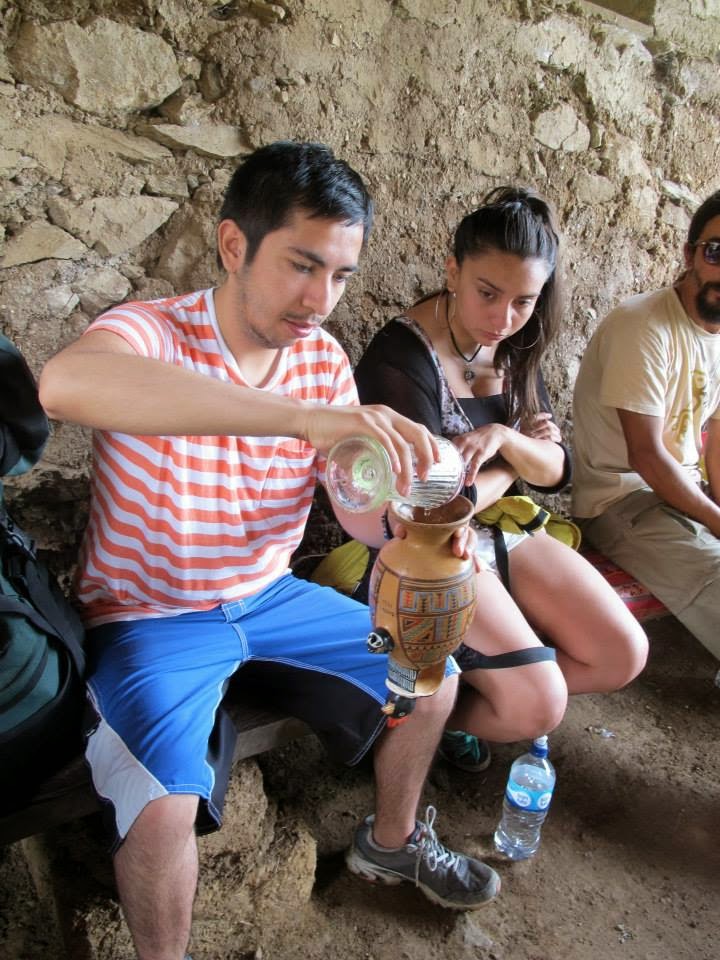
The talk was carried out in Spanish, so I didn’t understand everything, but something I found pretty fascinating was a water jug. The interior shape was such that when you turned it upside-down you could pour water into the hole at the base. You could then turn it back the right way without the water falling out, and pour it away through the spout at the top. It was so cleverly designed.

Water goes in the bottom...

...turn it over, the water doesn't spill...

...pour the water out of the spout!

We had a little time here for taking photos, and while doing so Grace and I spotted another pet monkey. This one was also tied up, but seemed much happier as its leash at least allowed it to be out playing and climbing in a more natural habitat. It was also a very friendly little thing, and we posed for some pictures with the little monkey on our shoulders.

The face paint was part of the cultural lesson, and came from the inside of a fruit


Returning to the shelter to get our bags ready to start trekking again, I suddenly noticed another creature had arrived and was eating some bananas that were set out for it. It was very relaxed and didn’t mind at all that a small crowd was gathering to admire it. It was very unusual, I had never seen anything like it before, and the guide didn’t know what it was called either – except that it was treated as a pet, but was a rare creature. It was so cute in the way it manipulated the bananas in its little hands, and with its snuffly nose investigating its surroundings. I still have to find out what this lovely creature is, but if anyone can assist then I would be really grateful!


Investigating my camera :)


The guides finally dragged everyone away from the monkey, kittens and the unusual creature, and we continued our trek. We climbed some more, although not as steeply now, and eventually came out to a high point where the track rounded a bend giving spectacular views over the valley with the Urubamba River at the bottom. At this point there was a small cave within the rocks to the side of the track, and our guides led us in an interpretation of an Incan ceremony during which we honoured Pachamama (Mother Earth) and placed offerings of coca leaves into the cave.

Coca leaves


After this we continued along the track, which was now traversing this high level along the side of the valley. We stopped a couple more times along the way for talks by the guides about the Incan culture, but mostly we walked. Then came some sections of steep downs to negotiate as well as ups and walking on more level ground. My legs, unaccustomed as they were to such exercise after a long rest-period for my hip bursitis, were tiring by now and unfortunately this caused me to slip as we were descending a section of steps and I twisted my ankle. It was painful but I ‘walked it off’, however I had to do this slowly and my spirits sank somewhat, along with my confidence in my ability to complete the trek, as I lagged behind the others. This disappointment was compounded as Grace and I noticed a heavy rain squall heading our way during one of the cultural talks.

We all set off again, but it was not long before the weather caught up with us and we were trekking through very heavy rainfall. I had to put my camera away out of the wet, which was a real shame as after this I saw a flock of macaws go by on several occasions. 

Last photo before the rain arrived and got too heavy


We trekked for some time now, trudging through the rain, and were told that we would have to use the cable car soon to cross the river; the bridge was not open when the river was in this much flow. This was all well and good until we cleared the jungle, walked along some rocky-shale paths for a while, rounded another cliff above the river, and saw the cable car: a single cable, suspended from cliff-to-cliff high above the raging river below, upon which was hung a plywood crate with a rope fixed at each end. The rope was attached to metal loops which were also threaded on the cable, so that a single giant loop didn’t form when the rope was slack, and the other ends of these ropes were attached to anchor stations for the cable on each side of the gorge. Not very high-tech or comforting at all!


There was a slightly wider flattened area carved out of the cliff as a waiting area beyond the narrow single-file track that preceded it. Therefore, with our group-size, it was a little time before I could see that what I had assumed was a mechanism to hoist the cable car, was in fact only an anchor point for the cable itself, and the hoisting of the cable car and its contents from one side of the gorge to the other was all done manually. Each time a group of us (2-4 people could fit in the cable car’s crate – with no proper seats or any safety equipment, just sitting in a crate with feet dangling over the side!) a man at one end would have to haul the rope to drag the crate and its contents across to his side. Watching what hard work it was for our guide to haul the empty crate back to our side for the next batch of travellers, I did not envy the cable car man his job AT ALL!

By this point I was feeling pretty exhausted: as I said before, I wasn’t really fit enough after a long-term period of resting a stubborn injury, lunch had come very late in the day, and now after waiting a long time in the rain for the back-and-forth journeys of the cable car to ferry everyone across the gorge, the chill damp was sapping more energy from me.

Although a bit sore, I was glad to finally get moving again once we were all safely on the far side, and as we continued trekking for another few hours the scenery changed and levelled out. We were no longer following steep valley sides, instead the ground was flattening out around us before rising up to hills again, and the walking was easier. The thought sustaining us at this point was that at the end of the road awaiting our arrival was a set of geothermal hot springs. What luxury for a weary traveller!

We talked of how wonderful we expected the springs to be, how they would soothe our aching muscles and relieve the weight from tired feet.

Image from www.panoramio.com


When we arrived at the pools, they did not disappoint. Once a little confusion over changing areas and baggage storage was sorted, we made our way down to the pools. There were three in total – one was for families with children only, and the other two were for adults. Large rectangular pools, the natural rock formed one side while the rest was man-made. The bottom was a coarse gravel – but not too coarse – and they were deep enough to cover my shoulders when I stood up straight. Leaning on the natural rocks at one side, I could even feel the hot volcanic water seeping through fissures in the stone. It was glorious, and as darkness fell and the stars began to twinkle, it only became more so.


Monday, 14 April 2014

Inca Jungle Trek, Peru ~ Day 1


Foreword: from November 2013 - February 2014, I went on a backpacking trip in South America, visiting Peru, Ecuador and Bolivia. 


Arriving in Cusco we had one main aim: to book onto an Inca Trail trek.

We hadn’t realised before our arrival how far in advance you need to book these treks. The trail is limited with regard to how many people can enter it each day, and these permits sell out fast. Luckily for us we were not there in peak season (no, not us – we had managed to be there for the gloomy, cold rainy season…) so we were able to get permits for 5 days later, which was no big deal to us as we had time and there was LOADS to do there. 

Plaza de Armas, Cusco


Unfortunately, while tramping up and down the many many steps that were all the rage in Inca times during excursions to the Sacred Valley, I lost confidence in my previously-injured-hip’s ability to cope with the Inca Trail and nights sleeping on the floor. This was a costly decision, as the Inca Trail permit couldn’t be refunded and also I would miss out on a World-class experience, but I managed to cut my losses by transferring onto the Inca Jungle Trek. This trek has more activities, opportunities to take an easy way out if my hip troubles me, and also it involves sleeping in beds (I’m not being a princess here, pressure on a hip bursitis/tendonitis is genuinely really painful. Even my own lovely comfy bed made it hurt horrendously when it was at its worst).

Many many steps at Ollantaytambo, Sacred Valley, Peru


On the first morning of the trek I was not in the best of spirits. My other half had left at 5am to head off for the ‘real’ Inca Trail, and I hadn’t been able to sleep since. My cold leftover pizza for breakfast did nothing to improve my mood, and neither did the 45 minute wait for my pick up at the main square. When my pick up arrived it was just a guy who came to show me where the actual pick up was, and once at the minibus it became apparent that I was the only English speaker. Still not a recipe for an improved mood…

On the road to Abra de Málaga


We eventually left, but not before being shouted at by police for being parked on yellow lines and then enduring some kind of domestic between the driver and the angry lady who paid the police fine. Once on the road however, the scenery was stunning. Mountains all around, little flocks of sheep or goats being shepherded about, plenty of llamas and alpacas decorated in brightly dyed yarn tassles, and even occasional pigs with their cute little piglets.

Cute little piglets


We stopped on the way to get a hot drink of coca tea and to stock up with snacks for the journey. Sipping my tea outside in the gradually strengthening sunshine, I got chatting first to a Brazillian girl with excellent English and Spanish, and then to a Chilean guy with English somewhat better than my Spanish (after all, I’d only had 2 weeks of Spanish lessons), and who was really lovely. He was travelling for just a couple of weeks with a friend of his, but she didn’t really speak any English and my Spanish conversation was not quite good enough to chat too much at first.


Feeling better for a hot brew and some companionship, I was able to enjoy the scenery much more, and I was pleased to find that I understood most of the briefings given by the guide in Spanish. We were heading for Abra de Málaga (4,350 meters), a high pass on this road through the Andes towards the jungle, offering a few hours of non-stop downhill bike riding. Pretty incredible.


The bikes we had did not inspire confidence, nor did the safety gear, however I was glad that I had stubbornly refused to buy a plastic rain poncho and instead had my own waterproof jacket. Up here there was a cold mist instead of the sunshine we had enjoyed further down, and rain was pretty much guaranteed so the waterproofing was necessary, but I didn’t fancy the idea of a: having all that wind drag to contend with from what I can only describe as an oversized, brightly-coloured plastic bat costume, or b: looking like a complete twerp from wearing what I can only describe as an oversized, brightly-coloured plastic bat costume.

Once on the bikes, we had a few rules to follow such as not overtaking each other (which lasted about 5 minutes!) and not crossing onto the other side of the road (which lasted until the really tight hairpin bends where my lack of rear brakes meant sticking to a tight turn was kind of tricky). It was a real shame that the ride was all about the speed – the route was all on-road so not especially interesting from a riding point-of-view, but from a views point-of-view it was utterly spectacular. The cloud forest was just beautiful, and from our vantage point as we began you could look out over miles of steep valley, sometimes catching sight of vultures soaring along below you. I would have dearly loved to be able to stop and take it all in in my own time, but sadly that was not on the program and we were only allowed one stop for taking in the sights. 


The rest of the time it was all about getting down as quickly as possible, and when I did try to take in the views while on the move I came very close to falling into the steep concrete drainage ditch at the side of the road! That would not have been a great start to my trek to Machu Picchu, but it probably would have been the end, so I had to give up on admiring the scenery too much.

As we dropped lower a stream developed out of the trickles of waterfalls higher up, and enlarged until it got to the point where it spilled over the road. Whizzing through this water got us thoroughly soaked – and again and again we passed through it as the switch-backs in the road cut back through its course. Soaked from the bottom upwards, torrential rain then began to soak us from above. Of course during this tropical downpour was the time my bike chose to get a puncture, and the poor driver of the minibus, who was following on behind the whole time as a safety vehicle, had to get out and sort out my tyre. I had lost all my speed in stopping like this, and we had reached the bottom of the downhill, so I had to pedal hard for the last section to reach everyone else, who were already stopped and waiting for the minibus which I had delayed. For this was the end of the cycle ride – well, cycle freewheel - and as we stopped so did the rain. The drop in altitude was significant enough for our location now to be pretty warm, and we gently steamed after our earlier drenching.

Even my camera steamed up!


The next phase was to go to Santa Maria and our lunch, followed by our accommodation for the night. (Some groups go on a short white water rafting trip at this point, but I hadn’t been told about this so wasn’t booked on it - gutted!).   Santa Maria is a small town but with lots of tourists as they pass through on the Inca Jungle Trek. Accommodation is basic, but as the guides were allocating rooms for our group and another group that had also arrived, my Chilean friends from earlier grabbed me and we managed to get a 3 bed room to ourselves. With not much to do, a giant queue for the only shower, and another deluge falling from the sky, my new Chilean friends and I passed the time by helping out with each other’s language skills and asking lots of questions about life in each other’s countries. 

Trying to photograph the rain at our accommodation for the night - you can see it pouring off the roof


Chatting away like this, dinner time soon came around, and our confidence in Spanish / English was also growing. By the time bed time arrived, I was in a much better frame of mind than earlier :)


Friday, 28 March 2014

Volunteering in the Countryside


Foreword: After returning from South America, I only had a short time until I needed to move out of where I was living, and would be staying in a different region of the UK for another short while (before then moving back to Pembrokeshire for a month, and then moving on to Australia!). I didn't have long enough to get a proper job before moving, so instead I did voluntary work for my local Wildlife Trust.


I often used to worry that ‘home’ would seem really boring after travels to exotic lands, but in actual fact I found that, after a few trips abroad, I actually gained more appreciation for what we have right here. I wonder why? I think maybe it’s because I’m learning to look at things differently :)

With free time on my hands, I decided to look for some voluntary work in countryside conservation. I have always been interested in nature and the countryside. I’d done voluntary work for various countryside organisations (Wildlife Trusts, the National Park etc) when I was younger, and had even studied countryside management at college for a bit before having to leave to find paid work. (I later saved up and went back to college then on to University to do something different).

I looked up my local Wildlife Trust, which from where I currently live is Berks, Bucks and Oxon Wildlife Trust. The Wildlife Trusts, 47 in total, are all over the country and cover geographical areas. They “stand up for, and look after, natural and wild places close to where people live”, carrying out conservation, habitat management and educational work. As charitable trusts, they are all dependent upon donations and they also make good use of volunteer workers.

College Lake


I found a nature reserve not too far from where I live, and although on the website it said that their volunteer work parties were currently full, I immediately wrote an email to the contact given. I got a reply the following morning, and after a couple of emails back and forth I had arranged to pop in that afternoon for a chat. Driving out to College Lake nature reserve I crossed from one side of the Chilterns to the other, a drive through some beautiful countryside. Owain, the warden, was a young guy who was clearly very passionate about his job and very knowledgeable. We had a lot to chat about with common interests in nature and travelling, and the outcome was that I decided to go back the following day to join the Wednesday work party.

After our chat, Owain loaned me his binoculars and I spent an hour or so enjoying the reserve. College Lake is an old chalk quarry, which was opened in order to supply a nearby cement works. Now flooded, the old quarry is a hugely important site for wetland birds, while the surrounding chalk grassland is very important for the UK's declining wildflowers – and subsequently the butterflies, bees and other insects that rely on these, therefore supporting further up the food chain with small mammals and birds of prey and so on.

I might be a bit old for a 'Duck Detective' sheet, but it did help!

Tufted ducks


Being early spring, the wetland area still has birds that are winter visitors, as well as new arrivals coming for the spring and summer. I’m not a bird watcher or ‘twitcher’, but I do enjoy seeing birds and knowing what they are, and I appreciate if I see something rare or unusual. I therefore picked a leaflet that was designed for kids, but provided a guide for the different duck species that were around. My favourites were the tufted ducks, which I just think look so cute, and the shoveler ducks, which just look really interesting with their strangely shaped beaks.

Shoveler duck


On the way home I drive past part of the Ashridge Estate, owned by the National Trust. Here I saw an impressive herd of deer, although with fading light the photos are less than impressive… I think these are Roe Deer, a species native to Britain, and I got out of the car and approached carefully behind the cover of some trees and scrub to get a better look at them. They look beautiful, elegant but nervous, I don’t get too close as they would only run off, but am content to look from a short distance and they gradually start to relax a little. I could stay much longer, but I have things to get back for so reluctantly I head back to the car and home.

Roe deer

Roe deer


The next day I return to College Lake to join the work party, carrying out practical tasks for maintenance and habitat management around the reserve. The tasks for the day start with shovelling and shifting wood chippings to help with path areas that have become boggy with all the rain that’s fallen. Then we set to work on scrub clearance, some cutting and others moving to keep an area clear of the scrubby bushes and small trees. It may seem strange to be cutting down trees and things in a nature reserve, but this particular area is at the top of a bank of chalk which is part of the site designated as a Site of Special Scientific Interest (SSSI) for its geology. This SSSI status means that it must be preserved as well as possible, so they have to ensure that the root systems of the plants don’t disturb the delicate chalk geology below. It’s a fine balance though – you don’t want to get rid of all the roots as this means there is no protection from soil erosion!

We broke for lunch and ate our sandwiches in the sunshine. There was plenty of cake too, as it happened to be the final day for a couple of volunteer veterans of 12 years, who were moving back to their (and my!) home county of Pembrokeshire, Wales the following week. Lunchtime over, as there was a newbie in the group Owain took us all on a tour of the reserve. As a newbie, this introduced me to the scale of the place and the habitats within, as well as teaching everyone a bit more about the management strategies for different ones. Plus, the volunteers get to see their work in context and see how their contributions help.

Results of some hedging done previously by the volunteer work team


We carry a telescope around with us on the walk, and every now and then we stop to look at the wildlife. We see some early butterflies, a buzzard and a kestrel. Someone with very keen eyes spots a hare – I see it through the scope, sitting down in grass with its ears flat down its back, but it’s too far off for me to get a picture. I love rabbits and grey squirrels, but I really love our own native wildlife and want to appreciate it more in the time I have left in the UK, so watching this hare feels very special.

Not my photo, but this hare is sitting just like the one we saw


We look at the birds again too, lapwings, red shanks, snipe, the various species of duck: tufted ducks, gadwalls, lots of wigeon and a couple of shovelers. College Lake is hugely important for lots of bird species, and makes home for a third of the Lapwings in the county as well as significant proportions of other bird populations. While this is great news that these handsome birds have somewhere ideal to live, it is also a sad indicator of the decline of these species in other areas.

I look forward to returning and learning more the following week, I find it so interesting and rewarding.


Afterword: I continued working at College Lake for all of the time I had left in the south of England. It was great fun and I got to work with some lovely people. Although I didn't have long there, I felt so welcome that I was really sad to leave it behind when I had to move. I totally recommend this kind of volunteer work to anyone who can do it, as it's so important and rewarding.