Sunday, 16 March 2014

In Search of Howler Monkeys


As part of our South American trip, we spent 2 weeks on the Ecuadorian coast learning Spanish at the MontaƱita Spanish School.

While idling around the town one day, indulging in the fantastic freshly blended tropical fruits juices available from almost any street corner, I overheard some people talking about how it was possible to see howler monkeys by going on a horseback trip into the Machalilla National Park

Any outdoorsy trip that involves wildlife is guaranteed to get me interested, so once our course was finished and we were leaving MontaƱita to head to the Andes, we first stopped off for a couple of nights in Puerto Lopez – a short bus ride up the coast.

There was plenty that could have kept me exploring around here for much longer, had time allowed, but as it was we just had time for the one trip. Booking a full day trip to go horseback trekking in the rainforest of the Machalilla National Park, we were met the next morning and driven to the hills behind the coast to meet our guide. It was a very small scale and informal affair, which felt perfect. We were dropped off our guide’s house where his wife treated us to a tour of their vegetable and fruit garden while he got ready.


Then we met our small horses, and began riding.


It was only a short ride on the road before we turned off on a track, and soon we were surrounded by the dry rainforest of the National Park.


Our guide (I feel terrible, but I don’t remember his name) was very knowledgeable about the local  flora and fauna, and although he did not speak English and our Spanish was minimal, with effort on both sides and some words luckily sounding similar in English and Spanish, then the bits we couldn’t fully understand we at least got the gist of.


The guide was very interested in the bromeliads. I was fascinated too – these colourful ones are on sale in British supermarkets as exotic pot plants. It felt incredible to see them just growing wild in the trees, far more beautiful than in garish plastic pots.


Looking carefully through the trees to spot the monkeys (los monos, in Spanish) our guide excitedly points out a bird to me. It is far away through dense foliage, but I can see it sitting there with its oversized bill – it’s a toucan! Such an iconic bird. This is possibly a Channel-Billed Toucan, as it doesn’t have such a brightly coloured bill, but there are over 40 species of toucan, so I’m not really sure.


The guide has been making monkey calls for a little while, so that when the monkeys call back in reply he can try to locate them. After quite some time of riding through the jungle the patience and careful looking pays off – signalling to keep quiet and pointing upwards, he directs us to some furry black shapes in the canopy above. A group of howler monkeys is moving through the trees above us!


We get some fantastic views, although my camera struggles to focus on the monkeys themselves with so many layers of leaves in between to confuse it.


The monkeys are fantastic to watch, carefully moving around the branches using their prehensile tails as an extra limb.


After watching a while, the monkeys seem to get concerned and alert.


The guide knows the signs and the animal calls well enough to know what this means. Moving quickly back to the path for a clearer view of the sky, he calls us after him. Pointing to a bird away in the distance, he explains that this is an eagle that preys on the monkeys. Amongst the largest eagles in the world, this is a harpy eagle.
Watching a short time, he becomes more excited – there is another eagle. As he explains that it is very rare to see two eagles, he is suddenly overcome with excitement. A third eagle has arrived! He has never in his life seen three eagles at once before, and he tells us we must be the first tourists to see so many together. They swoop through the sky, a male and two females perhaps, maybe fighting over territory or mating rights, before they disappear out of view. Incredible!


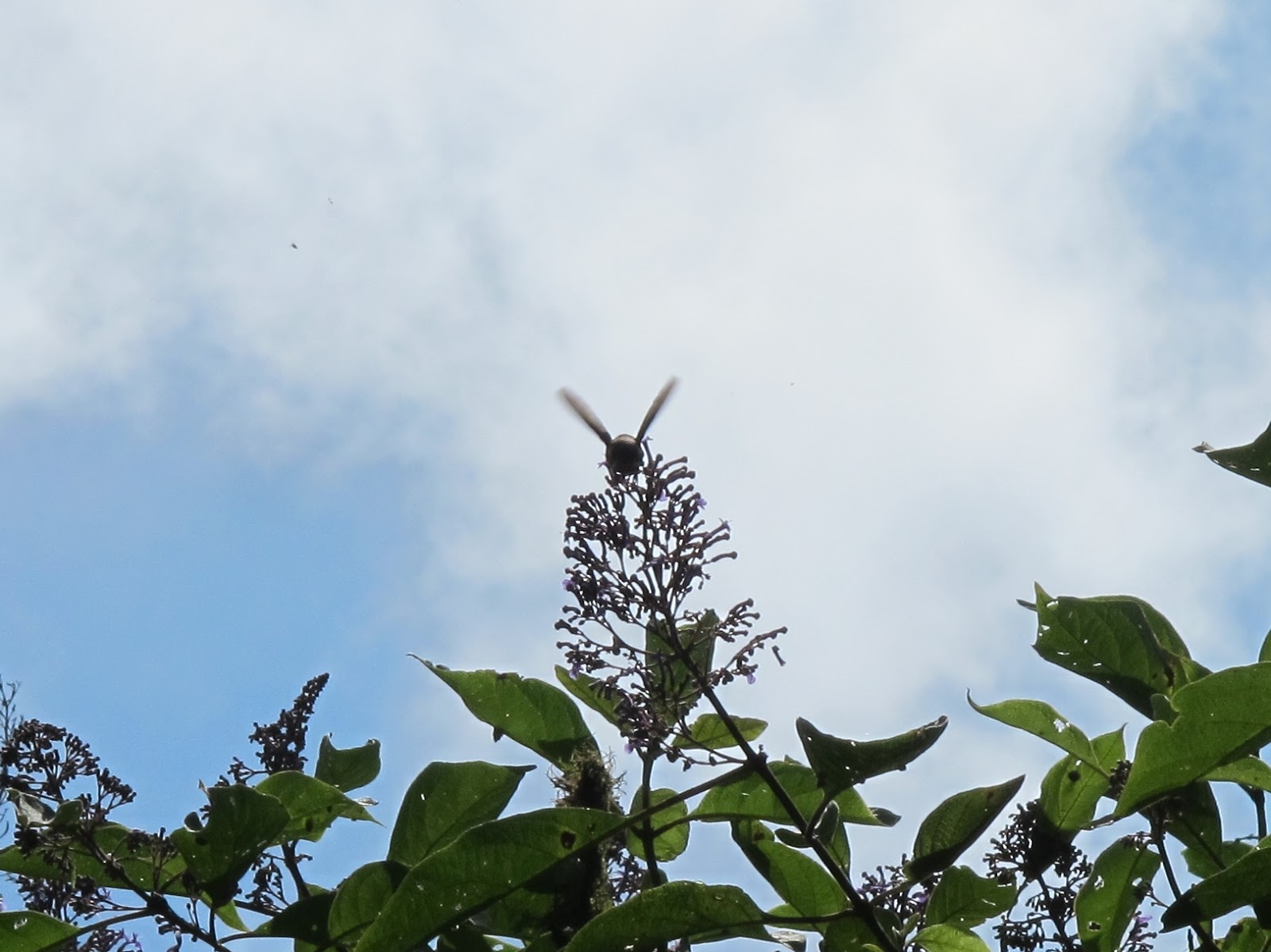
From the largest birds to the smallest: as we stop for a bit of fruit and a leg stretch at a viewing platform on the way back, we are treated to the equally special sight of an Esmeralda Hummingbird, one of the World’s smallest and rarest hummingbirds. Barely bigger than a bumblebee, this little beauty was in stark contrast to huge eagles from earlier, with their wingspans of around 2 metres.


Our day of riding through the jungle is coming to an end, and although we have to head back now I can’t feel sad that it's over – I’m too busy still processing how many incredible things I have seen since breakfast!


Friday, 14 March 2014

In Pictures: Galapagos


Foreword: from November 2013 - February 2014, I went on a backpacking trip in South America, visiting Peru, Ecuador and Bolivia. 


Yes I do!

I wrote about visiting the Galapagos Islands independently, but I also want to show off some of the wildlife I encountered. Enjoy!


Lava lizard

Brown pelican

Snuggling marine iguanas


Flamingo

Sally Lightfoot crab

Galapagos penguins - the only type of penguin to live wild north of the equator

Blue-footed boobies

Baby sea lion, incredibly cute

A noble looking male marine iguana

Swimming with the sea lions - they seemed to love floating upside-down at the surface to get a good look at you

Beautiful turtle

I still need to identify this bird

Lava lizard

Black-tipped reef sharks hunting at night. The bright green colour comes from the lights on the jetty.

Wild giant land tortoise

Lava gull - one of the rarest gulls in the world, the entire population lives on the Galapagos and is estimated at only 300-400 pairs


Friday, 28 February 2014

New Year in BaƱos


Spending New Year’s Eve in a different (warmer!) country, surrounded by other travellers, gives you the chance to do something a little different to normal.

We still had time planned in Quito, where we had spent Christmas,  but having heard that it was a good place for more active pursuits, we decided to jump on a bus to BaƱos for a couple of days over New Year. 


And that’s how we found ourselves with an early start on New Year’s Eve, crammed into neoprene, crammed into the back of a 4x4, and heading up a hill.


There was more heading uphill still to come – this time on foot.


But we were really there for the ‘down’ bit;


Abseiling down the waterfalls to be precise! 


I had always wanted a go at canyoning, and although I was feeling a bit shy in the group setting, it was still good fun :)


I can often be identified as the shortest person in a picture...


Returning to the town after a fun-filled few hours, we discovered that everyone gets dressed up in crazy costumes for New Year. They roam the streets messing around, stopping cars or grabbing people for money (just small change in the name of fun – not actual kidnappings!)  Masks feature heavily, as do wigs and drag costumes. 


A group of young guys in drag surround someone until they are given some money. Sounds more sinister than it was!


I put on my brightest t-shirt, and popping into some local shops we join in with the spirit of the night.

You can't quite tell, but I had multi-colour glittery fake eyelashes to match the wig!

 Drinks flow, out on the streets and inside the bars

Not sure what this drink was, but it was warm and tasty. And that lady has a fine taste in crazy wigs ;)

Flaming welcome drinks - if you drank them in one they were on the house.


At midnight came fireworks, and the torching of the various papier mache models that had been created for the night. Think a mixture of Guy Fawkes night and American-style Halloween, on steroids...


~ Adventures can be cultural too!


Sunday, 22 December 2013

Independent Galapagos


Foreword: from November 2013 - February 2014, I went on a backpacking trip in South America, visiting Peru, Ecuador and Bolivia. 


In planning our trip to South America, the Galapagos Islands were pretty much number 1 on my ‘not to miss’ list.

They are expensive to visit, and on top of the cost of getting there you have to pay US$100 as an entrance tax to the islands (though you get a very cool passport stamp in return). "Cash is King" on the islands too, and trying to pay by plastic will result in very heavy price mark-ups. This can all be mitigated though, by bringing plenty of cash with you, and by planning your trip independently.

Most people visit the islands by cruise boat. There are various different classes of cruise boat at different prices and offering different types of trip, however I didn’t really fancy this - the cruises were really a bit out of our price range, I was anxious at the thought of getting sea sick and being unable to enjoy the islands fully, and I also didn’t like the idea of having every minute of my day dictated by the group timetable. I wanted to be able to wander and discover things for myself.

Against the advice of the hostel manager in Guayaquil, from where we organised our trip, we bought only flights; from Guayaquil to Baltra (for access to Santa Cruz island) and back from San Cristobal island. I organised the rest myself, looking up reviews for accommodation and seeking out day trip itineraries. We didn’t have long enough to do too much – I mean, I could have easily spent the full allowable 6 months there without ever getting bored! – but the islands are so incredible that even a 5-day stay will remain fondly in your memory forever.

I was surprised at how many accommodation options there were on the Galapagos, some sounded fantastic but were far too expensive for us, but despite warnings from Guayaquil (where people are, after all, trying to sell you their trips) there was a great choice of more budget accommodation options.

Giant land tortoise, Isla Santa Cruz


A special mention really needs to go to the hostel I booked in Puerto Ayora, the main town on Santa Cruz island. Galapagos Best Homestay hostel was really reasonably priced considering the unique location, US$20.00 a night for a room in a nice clean dorm, which included a kitchenette and bathroom, free drinking water in the room, and access to free internet (although this is a bit slow as Galapagos internet is only via a satellite connection and so is limited). Most significantly, Kevin from the hostel not only emails you all the information you need to easily find your way to the hostel when you book, but when you arrive he also takes you on a free orientation tour of the town. This tour was invaluable. Restaurants, tour companies, internet availability, places to walk to, places to buy groceries from, best times to visit, everything is pointed out to you so you really can get the most out of the time you have there. He must have saved us an entire day – if not more – of wandering around trying to figure things out and trying to find the best ways to do things. Some elements we may never have realised without his help.

On the website, they say:

What I find most rewarding is when my guests come back for the night and tell me what a great day they had exploring the Galapagos. They tell me about all of the places and animals that they saw and how special it is that the animals are not afraid of them. Then they go on to say 'Thank You, Kevin' for the tour of the town and telling us what we can do here, it was so helpful. They then go in to town with the new friends that they met here at the Hostel. This is very heart warming for me. Because I do care about my guests and that they have a good time here. I feel that the mission of the hostel has been accomplished. It has never been about the money, but to provide a nice clean comfortable place to stay while you are here to explore the Galapagos."

And while this sounds too good to be true, it is in fact a very true reflection of we what we found at the hostel.


Bringing in the catch, Puerto Ayora


From Puerto Ayora itself there is quite a bit you can do and see without even booking a tour – excellent if you are on a very tight budget:


  • Enjoy the town: in Puerto Ayora itself you can see all manner of wildlife; sea lions, Sally Lightfoot crabs, pelicans, frigate birds, marine iguanas, various finches, sharks and rays from the jetty, the list goes on. There are also plenty of great places to eat (don't miss a lobster dinner at the Kioskas!), and shops for souvenirs – everything from the usual cheesy fridge magnets and t-shirts to proper gallery pieces.
  • Walk to the Charles Darwin Research Station: see the results of the land tortoise captive breeding program – otherwise known as baby tortoises!
  • Walk to the beautiful white sand beach of Tortuga bay: swimming here is forbidden, but following the beach as it bends around to the right, past some mangroves, and you can swim there quite happily. You have to sign in and out at the start of the path with the Galapagos Park Service office, and it is open from 6am to 6pm.
  • Swim in Las Grietas: I did not have time to fit this in as well as everything else, but I would love to do it if I can go back one day. A water taxi from Puerto Ayora followed by a walk takes you to this beautiful swimming site. For directions, see this galapagosislands.com write up.  
  • See giant land tortoises in the wild: for US$30 you can hire a taxi to take you up to the highlands and El Chato, where you can walk amongst the wild tortoises. The $30 is per taxi, so if you have / can gather some friends to come along, then you can split the cost. On the same trip you can walk through some large lava tunnels – created when the molten lava within continued flowing out of the cooled external layer, leaving behind these large tunnels.
  • Watch the catch come in: in Puerto Ayora in the morning you can watch the fishermens' catch arriving and being prepared – and being begged for by jostling crowds of sea lions, pelicans and frigate birds!

Tortuga Bay, Santa Cruz


If you want to island hop, a ferry boat can take you to San Cristobal for US$30 one way, from where there are more free/cheap sights. The main town is much more basic here, and it is harder to find good restaurants. However there is cheap accommodation available and still plenty to see! I was only on this island for just over a day, so I have fewer options to offer from experience, but I’m sure could find more if you were there:


  • Discover Galapagos history at the interpretation centre: You can walk here from the town or take a taxi, and read about the natural and human history of the islands. From the back of the centre you can also take a path to the beach where you can swim with sea lions and sea turtles. Sea turtles are just incredible.
  • Walk the coast and enjoy the beaches: there are several spots where you can walk coastal paths to spot wildlife and take in scenery, or swim with the animals from the beaches. Ask directions once you’re there, or just take off and explore!

I didn’t get to stay on any other islands, but I did also visit Isabella as part of a day trip. This was a beautiful island with a very laid back relaxed vibe, and I thought it looked like a lovely place to stay if you had time (I saw a nice looking hostel here too, though I don't know the name). There was a flamingo lagoon, surfing opportunities, nearby lava islets to visit on boat trips… I would definitely head there on a future trip. There is a landing fee of US$5 for this island.

Swimming with sea lions, San Cristobal


In addition to these low budget options for enjoying the islands, there are plenty of tour operators in the towns that you can visit for more day trips. These vary in price depending on how far you travel, what activities are involved etc etc. If you can already dive there are many diving options, in fact some places can only be visited by the dive trips. It’s not a great place for beginner divers due to the strong water currents, but there are also plenty of snorkeling options for non-divers. You can snorkel independently from various beaches, but there are some great snorkel boat trips you can go on.

Young marine iguanas


My favourite and much recommended snorkel trip was to Kicker Rock. This involves a boat trip out to the rock, which is an old lava plug that has split in two, leaving a bit of a canyon in between through which you can snorkel (or dive). Assisted by the current you swim/drift through, while being mesmerised by the sights of various reef sharks, rays and sea turtles along the way. We went through twice, with a lunch break in between. On the second occasion, towards the end, there were quite a few sharks below us. Then more. And more. In the end there must have been literally hundreds of them – more than the guide had ever seen at once before. He was so excited he was waving and shouting out to people to come and see this phenomenal sight. It was breath-taking! Also very special was duck diving down to follow a convoy of three eagle rays swooping past with their magnificent ‘wings’ gliding them through the water. Sadly none of our photos remain from this trip as the camera with its memory card in was stolen when we got back to Guayaquil. 

Kicker Rock (from Wikimedia Commons)


For me, the beauty of doing these day trips rather than doing a full cruise itinerary was that you could fully tailor your experience to your budget and interests. I did the trips I wanted to, my husband did what he wanted, we were both happy, and in the evenings we were free to explore and find restaurants that we liked for dinner, get a drink if we wanted to, and did not have to get back to a boat for a certain time.

If you want to do an organised trip to the Galapagos, then go for it – I have no doubt that you would have an incredible time.

But if you want to see the Galapagos independently? Then do just that – don’t let anyone put you off! 

A magnificent marine turtle